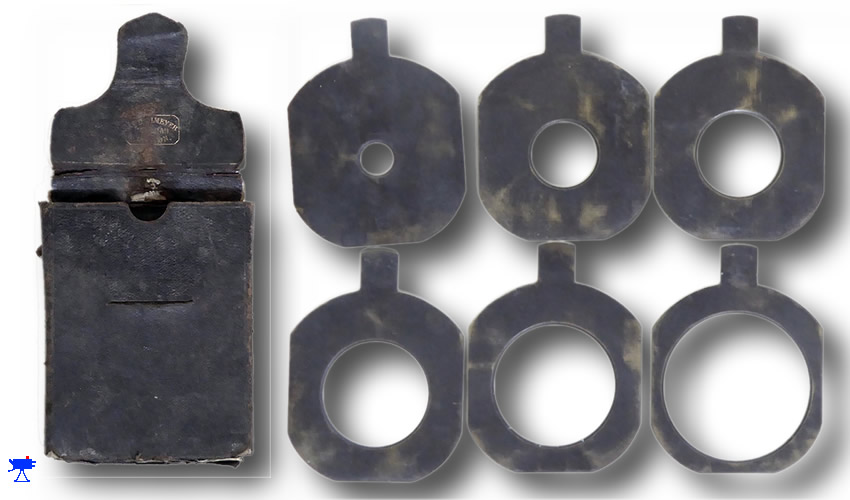
Waterhouse stops
A system of interchangeable fixed-size aperture plates.
"In the mid to late 1800s camera lenses did not have adjustable iris-type aperture diaphragms as they do today. Instead they either were used wide open or else employed a system of interchangeable black metal plates. These plates, which were inserted into a slot on the side of the lens barrel, had holes drilled into them. The photographer would adjust the lens aperture by swapping out one plate for another with a different size of hole. These plates were named Waterhouse stops, apparently after the inventor who came up with the system in 1853 or 1858 or thereabouts."
These were used on early TV camera lenses, that did not have an adjustable Iris, to control the amount of light transmitted so as to match other lenses in use.
Typically long focal length lenses 25 or 40 inches.
The transit pouch appears to say "Dallmeyer"

 Back